Last updated: October 2026
Short answer: A fake credit card number generator creates numbers that look valid but aren't tied to any real account. They're useful for software testing and form validation. They can't make real purchases, unlock free trials, or verify accounts, and using them that way can be illegal.
What Is a Fake Credit Card Number Generator?
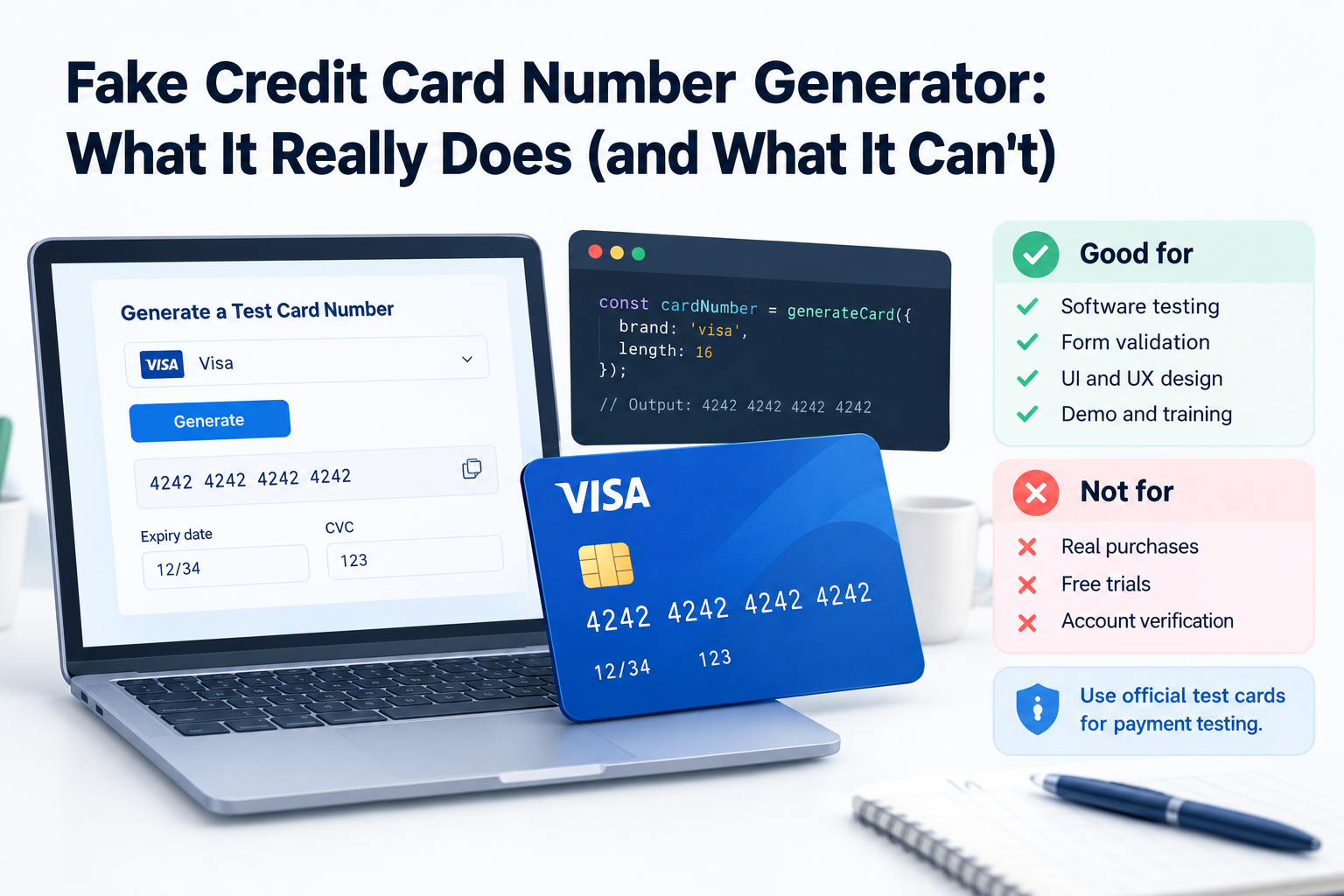
A fake credit card number generator is a tool that produces card-style numbers following the correct structure for a given network, such as Visa, Mastercard, or American Express. Developers and QA testers use them to fill out forms and check that software handles card input correctly.
The numbers are syntactically valid, meaning they pass format checks. They are not real, because no bank issued them and no account sits behind them.
How Do These Generators Work?
Most generators combine three pieces of the card number structure:
- The issuer identification number (IIN): the first digits, which signal the network (for example, Visa cards start with 4).
- Account digits: the middle digits, often random.
- A check digit: the final digit, calculated with the Luhn algorithm, a checksum that catches typing errors.
Because the output satisfies the Luhn check and the correct length, many basic validation forms will accept it. That's the full extent of what these tools can do.
What Generators Can't Do
This is where most searchers get misled. A generated number cannot:
- Complete a real purchase. The card issuer finds no matching account and declines the payment.
- Pass a real payment authorization. Authorization checks that the account exists, the expiration date and CVV match, and funds are available.
- Reliably unlock free trials. Most trials check the card with the issuer, often with a small authorization hold.
- Work on live checkouts. Processors flag repeated failed attempts and can block your IP address or account.
Legitimate Uses
Generators have genuine, legal uses when applied to testing:
- Form validation: checking that a field accepts the right format and rejects the wrong one
- UI and UX design: populating mockups and demos with realistic-looking data
- Automated testing: filling forms in test suites that never submit a real payment
- Training and documentation: screenshots and tutorials that shouldn't show real data
For anything that processes a payment flow, use your payment provider's official test cards instead of a random generator. For example, Stripe's testing documentation publishes test numbers that work in test mode and simulate outcomes such as successful payments, declines, and 3D Secure authentication. Stripe also advises using test API keys and prohibits testing in live mode with real card details.
Generator vs. Official Test Card
| Random generator | Official provider test card | |
|---|---|---|
| Passes format check | Yes | Yes |
| Works in a payment sandbox | Usually not | Yes, in test mode |
| Simulates declines and authentication | No | Yes, by design |
| Documented and supported | No | Yes |
| Best for | Basic form and UI testing | Testing real payment flows |
The Risks of Using Generator Websites
Searching for generators brings its own dangers:
- Malware and scams. Many generator and "working card" sites are built to push downloads, harvest your data, or redirect you to fraudulent offers.
- Stolen data. Some sites that claim to offer "live" cards are actually sharing stolen card numbers. Using them is very likely to constitute credit card fraud, and the penalties can be severe.
- Account bans. Entering fake numbers on live sites can get your account or IP address blocked.
- Legal trouble. Using a false card number to get goods, services, or trials can amount to fraud in many jurisdictions, though specifics vary.
Is It Legal?
Creating format-valid numbers for software testing is generally legal in most jurisdictions. Using any fake or generated number to obtain something of value is widely prohibited, though the exact offense and penalties differ by country. Using a real person's card number without permission is almost universally treated as fraud. Laws vary considerably, so check your local rules if you have a specific use in mind.
Safer Alternatives
| If you want to... | Use this instead |
|---|---|
| Test a payment integration | Your payment provider's official test cards, in test mode |
| Fill a demo or mockup | Clearly fictional placeholder data, such as "XXXX XXXX XXXX 1234" |
| Try a free trial without exposing your main card | A virtual card with a spending limit from your bank or a virtual-card service (availability varies by region) |
| Avoid surprise charges | A calendar reminder to cancel, or a low-limit virtual card |
| Protect yourself from card theft | Transaction alerts and two-factor authentication |
Frequently Asked Questions
Do Fake Credit Card Generators Really Work?
They work only in the sense that the numbers pass format checks. They can't complete real payments because no account exists behind them.
Can I Use a Generated Card Number for a Free Trial?
Usually not. Most trials verify the card with the issuer. Using a fake number to get one may also violate the service's terms and, in many places, the law.
Are Credit Card Generators Legal?
Generating numbers for testing is generally legal in most jurisdictions. Using them to obtain goods or services is widely prohibited, though enforcement and classification vary.
What's the Difference Between a Generator and a Test Card?
A generator creates arbitrary format-valid numbers. A test card is published by a payment provider and works in its sandbox to simulate specific outcomes.
Why Do Some Generator Sites Ask for Downloads or Personal Info?
That's a red flag. Legitimate testing doesn't require them, and many such sites are scams or malware vectors.
What Should I Use to Test My Checkout?
Use your payment provider's official test cards and test API keys, as described in its developer documentation.
Final Thoughts
A fake credit card number generator is a testing tool, not a way to pay for anything. Use official test cards for payment development, clearly fictional placeholders for demos, and virtual cards when you want privacy or protection for real purchases. If a site promises "working" fake cards, it's either selling a scam or selling stolen data.
Disclaimer: This article is for general information. Follow your payment provider's documentation and the laws in your jurisdiction.