
Last updated: November 2026. Security features checked against the U.S. Currency Education Program.
Picture this: someone hands you a crisp $100 bill for a sale, a rent payment, or change from a stranger. It looks fine. But $100 is a lot of money to be wrong about, and a counterfeit $100 bill can be hard to spot at a glance.
The good news is that you don't need special equipment. The U.S. government designed the $100 note so anyone can check it using three simple actions: feel, tilt, and check. This guide covers how to tell real vs. fake $100 bills, for both the current design and older notes.
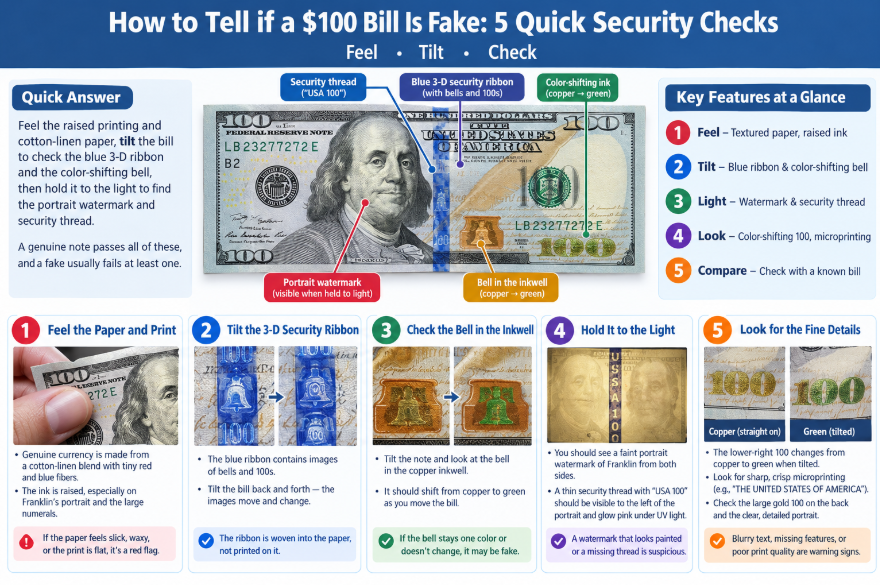
Quick answer: Feel the raised printing and cotton-linen paper, tilt the bill to check the blue 3-D ribbon and the color-shifting bell, then hold it to the light to find the portrait watermark and security thread. Check several security features together. A genuine note should display the features appropriate to its design, while a suspicious note may show inconsistencies. No single quick test can conclusively authenticate every banknote. For older bills, first identify the design and series, then check only the features that design has. See the older-bill section below.
The five checks below apply to the current-design $100 bill, introduced in 2013. Older $100 bills remain legal tender, but their security features differ by design. Check the features that match the note's series rather than expecting every modern feature on an older bill.
Real vs. Fake $100 Bill: 5 Quick Checks for the New Design
Check 1: Feel the Paper and Print
Before you look at anything, touch the bill.
- The paper: Genuine U.S. currency is printed on a blend of cotton and linen, with tiny red and blue security fibers woven in. It should feel slightly textured and sturdy, not slick, waxy, or like ordinary printer paper.
- The ink: The printing is raised, and you can feel it throughout the note, especially on Benjamin Franklin's shoulder and the large numerals. A flat, smooth print is a warning sign.
Check 2: Tilt the 3-D Security Ribbon
This is one of the hardest features for counterfeiters to fake.
- What to look for: The blue ribbon on the front, to the right of Franklin's portrait, contains images of bells and 100s.
- What it does: Tilt the bill back and forth while focusing on the ribbon. The bells and 100s move and change from one to the other.
- Why it matters: The ribbon is woven into the paper, not printed on it. On many fakes, it's a flat printed stripe, or the images don't move.
Check 3: Tilt for the Bell in the Inkwell
- What to look for: A bell inside a copper inkwell on the front of the bill.
- What it does: When you tilt the note, the bell shifts from copper to green, so it seems to appear and disappear inside the inkwell.
- Red flag: No color change, or a bell that stays one flat color.
Check 4: Hold It to the Light
Two features reveal themselves when light passes through the paper.
- Portrait watermark: A faint image of Franklin appears in the blank space beside the portrait. It should be visible from both sides of the bill. A watermark that looks painted or stamped on the surface is suspicious.
- Security thread: A thin vertical thread is embedded in the paper to the left of Franklin's portrait when you view the front. It's inscribed "USA 100." On a genuine note, you can see it from both sides when held to light.
Check 5: Look for the Fine Details
If you have a little more time, look closely. A magnifying glass helps.
- Color-shifting 100: The numeral 100 in the lower right corner of the front changes color (copper to green) when tilted.
- Microprinting: Tiny, sharp text appears in several places, including "THE UNITED STATES OF AMERICA" on Franklin's collar and "ONE HUNDRED USA" along the golden quill. On fakes, microprinting often looks blurry or broken.
- Gold 100: A large gold numeral 100 appears on the back.
- Overall print quality: Franklin's portrait should look crisp and detailed, without smudges, fuzzy lines, or washed-out colors. Order fake USD bills
How to Check an Older $100 Bill: Identify the Design and Series First
If you're wondering how to tell if an old $100 bill is fake or real, start by identifying which design you're holding. "Older" covers several generations of $100 notes, and they do not all share the same features. Don't assume every note issued before 2013 has the same security features.
Step 1: Find the series year printed on the front of the note.
Step 2: Match it to a design:
- 1996–2013 design: series 1996, 1999, 2001, 2003, 2003A, 2006, and 2006A.
- 1990–1996 design: series 1990 and 1993.
- 1914–1990 design: all earlier series.
Step 3: Check only the features that design has.
1996–2013 design
- Paper and print: Cotton-linen paper with red and blue fibers, and raised printing you can feel.
- Portrait watermark: A faint image of Franklin visible from both sides when held to the light.
- Security thread: A thin embedded thread inscribed "USA 100," visible from both sides when held to the light. It glows pink under ultraviolet light.
- Color-shifting 100: The numeral 100 in the lower right corner of the front shifts from green to black when tilted.
- Microprinting: "USA 100" within the numeral in the lower left corner, and "THE UNITED STATES OF AMERICA" in the line on the left lapel of Franklin's coat.
1990–1996 design
- Paper and print: Cotton-linen paper with red and blue fibers, and raised printing.
- Security thread: An embedded "USA 100" thread to the left of the portrait, visible from both sides and glowing pink under ultraviolet light.
- Microprinting: "THE UNITED STATES OF AMERICA" along the outer edge of the portrait's oval frame.
- This design has no portrait watermark or color-shifting numeral, so their absence is not a red flag.
1914–1990 design
- Paper and print: Cotton-linen paper with red and blue fibers, and raised printing.
- These notes predate the security thread and microprinting, so there are fewer features to check. Rely on the paper feel and print quality, compare the note with a known genuine bill, and ask a bank if you're still unsure.
What no older design has: The 3-D security ribbon, the bell in the inkwell, and the large gold 100 on the back were introduced with the 2013 design. Don't treat their absence as a red flag on an older bill. Do be suspicious if a bill claims to be the new design but lacks them.
Where your design has them, check at least two or three features. Because older notes have fewer features, comparing the suspect bill with a known genuine bill from the same era is especially useful. Explore paper money forums
Old vs. New $100 Bill: Quick Comparison
| Feature | Older design | Current design |
|---|---|---|
| Cotton-linen paper, raised ink | Yes (all older designs) | Yes |
| Portrait watermark | 1996–2013 series only | Yes |
| "USA 100" security thread | 1990 and later series; not on earlier notes | Yes |
| Color-shifting 100 | 1996–2013 series only (green to black) | Yes (copper to green) |
| Microprinting | 1990 and later series (location varies by design) | Yes |
| Blue 3-D security ribbon | No | Yes |
| Bell in the inkwell | No | Yes |
| Gold 100 on the back | No | Yes |
For the exact placement and appearance of each feature on a specific series, see the U.S. Currency Education Program pages listed under Official Sources. Learn most realistic prop money that's legal
Quick Reference: Current $100 Bill
| Feature | How to check | What a real bill does |
|---|---|---|
| Paper and print | Feel it | Textured, with raised ink |
| 3-D security ribbon | Tilt back and forth | Bells and 100s move and change; woven into the paper |
| Bell in the inkwell | Tilt | Bell shifts from copper to green |
| Portrait watermark | Hold to light | Faint Franklin visible from both sides |
| Security thread | Hold to light | "USA 100" thread, left of the portrait |
| Color-shifting 100 | Tilt | Lower right numeral shifts color |
| Microprinting | Magnify | Tiny, crisp text in several places |
Don't Rely on These
- Counterfeit detector pens. They test for starch in the paper, which can produce false results either way. Some fakes pass, and genuine bills can occasionally fail. Use the physical features above instead.
- A single check. Check at least two or three features, since counterfeiters sometimes copy one well.
- The bill's color alone. A good fake can look right at a glance.
- Your impression of the person. Anyone can unknowingly pass a fake. Judge the bill, not the person.
Compare With a Known Genuine Bill
If you're still unsure, put the suspect note next to a bill you trust. Compare the paper feel, the print quality, and each security feature. Differences between the two are the clearest sign something is wrong.
What to Do If You Think a $100 Bill Is Counterfeit
Counterfeit money has no value, and knowingly passing it is a crime. The exact procedure for handling and reporting a suspect note can vary by location, so follow the instructions of the relevant police department, bank, or official currency authority. In general:
- Don't pass it on. Never try to spend it or hand it to someone else.
- Handle it as little as possible. Place it in an envelope or other protective cover.
- Write down the details. Note where and when you received it, who gave it to you, and any description you can safely record.
- Don't confront anyone. Your safety comes first.
- Contact the right authority. In the U.S., that's typically your local police or the U.S. Secret Service. Outside the U.S., contact your local police, your bank, or the country's central bank, and hand the note over only as they direct.
Frequently Asked Questions
How Can You Tell if an Old $100 Bill Is Real?
Identify the design and series first, then check the features that design has. Notes from the 1996–2013 designs have the portrait watermark, "USA 100" security thread, color-shifting 100, and microprinting. The 1990–1996 design has the thread and microprinting but no watermark or color-shifting numeral, and earlier notes have neither thread nor microprinting. No older design has the 3-D ribbon or the bell in the inkwell, so don't expect them. Compare the note with a known genuine bill if you can.
Do I Need to Replace Older $100 Bills?
No. Older $100 bills remain legal tender and don't need to be exchanged. Their security features differ by design, so check the features that match the note's series.
Can I Check a $100 Bill With Just My Phone?
A phone flashlight helps with the watermark and thread, but no consumer app is as reliable as the physical checks. Use the tilt and light tests.
Are UV Lights Worth Using?
They can help. On the current $100 note, the security thread glows pink under ultraviolet light. Still, don't rely on UV alone. Use it alongside the feel and tilt checks.
What If a Bank or Store Refuses My $100 Bill?
Ask why, and request that they check it using the security features. If you believe it's genuine, a bank can verify it for you.
Does "Prop Money" Count as Counterfeit?
Movie or novelty bills are often printed with markings such as "for motion picture use only." Using them as payment is illegal, and they're easy to spot because they lack the security features. Guide on how to spot fake money
What If I Received a Counterfeit by Accident?
You can't recover its value, but reporting it promptly helps protect others and helps authorities track counterfeiters. Be aware that some counterfeit USD 100 banknotes in circulation are sophisticated enough to pass a casual glance, which is why the full set of physical checks matters.
The Bottom Line
You don't need to be an expert to protect yourself, but you do need to check the right things. Start by identifying the note's design and series, then use the features appropriate to that design. On a current-design note, feel the paper and raised ink, tilt the bill to see the ribbon and bell move and change, and check the watermark and security thread against the light. On an older note, rely only on the features its series actually has, such as the thread, microprinting, and, on 1996–2013 notes, the watermark and color-shifting 100. It takes only a few moments, and it can save you $100.
Official Sources
- U.S. Currency Education Program: $100 note security features (web version of the Decoding the $100 brochure)
- Decoding the $100: Feel, Tilt, Check (PDF) (current design: paper, ribbon, bell, color-shifting numeral, watermark, thread)
- $100 note features guide, issued 2013–present (PDF) (adds microprinting, gold 100, fibers)
- $100 note features guide, issued 1996–2013 (PDF)
- $100 note features guide, issued 1990–1996 (PDF)
- $100 note features guide, issued 1914–1990 (PDF)
- U.S. Secret Service: counterfeit currency
Disclaimer: This article is for general information. Follow guidance from your local police, bank, or official currency authority if you suspect counterfeit currency.